



Nurturing Minds through COGNITIVE DEVELOPMENT
Kindergarten often referred to as preschool or pre-primary education, is a crucial foundational stage in a child’s academic and social development. It typically serves as the first formal educational experience for young children, typically aged between three and six years old.
At Neerja Modi School our kindergarten children are engaged in a variety of activities designed to stimulate their cognitive, emotional, social, and physical growth. These activities often include storytelling, singing, arts and crafts, outdoor play, and guided group activities. Through these experiences, children develop essential skills such as language and literacy, numeracy, fine and gross motor skills, problem-solving abilities, and social interaction skills.
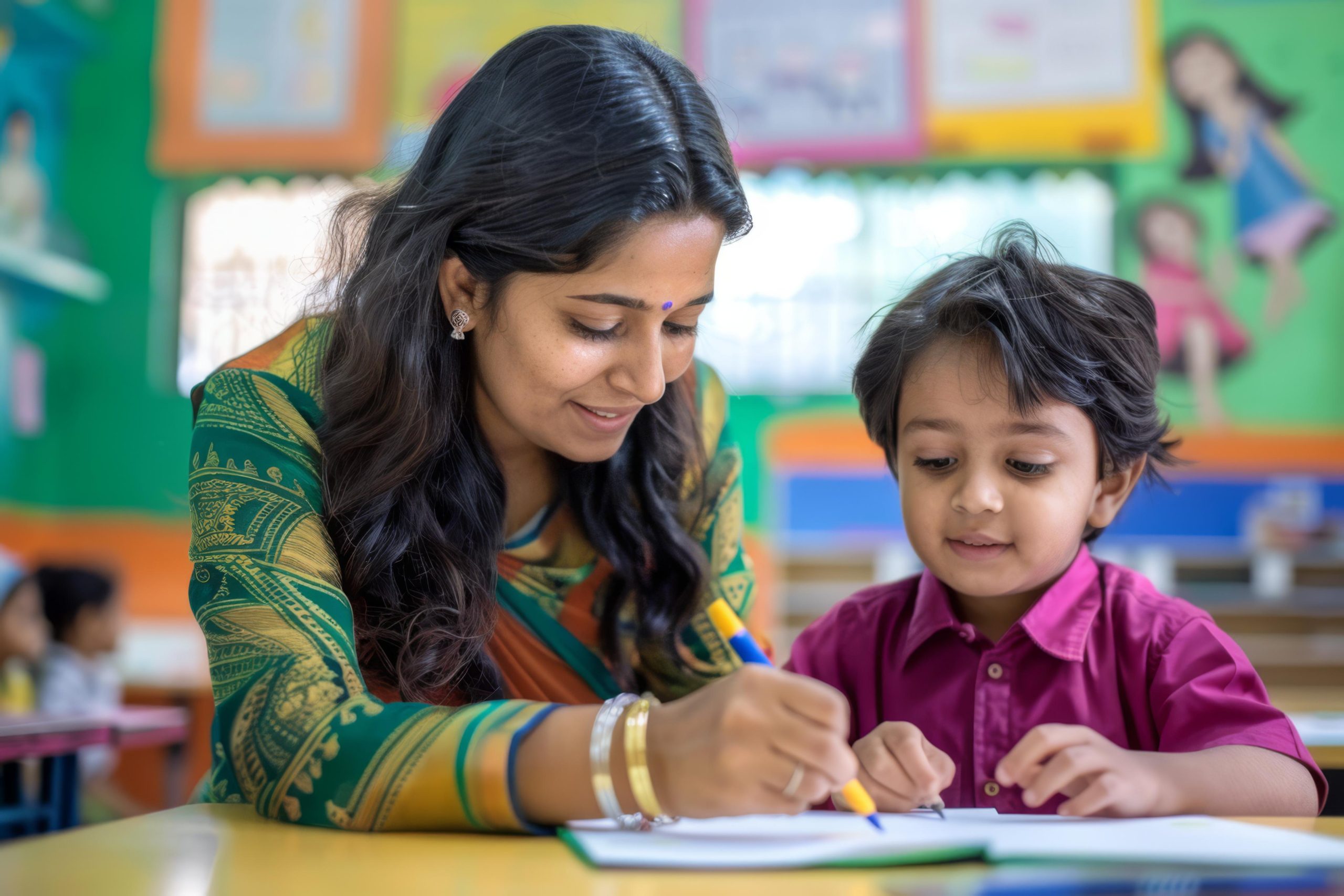
Empowering Hearts, Building Bonds with SOCIAL & EMOTIONAL DEVELOPMENT
Social and emotional development is a critical aspect of a preschooler’s growth at Neerja Modi School. It plays a fundamental role in shaping their overall well-being, relationships, and future success. Supporting social and emotional development in preschoolers involves creating a nurturing and inclusive environment that encourages exploration, self-expression, positive relationships, and emotional well-being.
Play with Purpose throughCONSTRUCTIVE AND WELL STRUCTURED SPORTS
Constructive and well-structured sports activities for preschoolers can provide numerous benefits, including physical development, social interaction, and the cultivation of essential skills such as teamwork and coordination.Some examples of sports activities suitable for preschoolers which are conducted in our school like ball games,yoga,hurdles , parachute play etc.
Life's Playbook: Cultivating ESSENTIAL LIFE SKILLS
PARSHV AJIT VIDHYAPEETH believes that preschool is a crucial time for children to start learning essential life skills that will serve as building blocks for their future development and success. These skills encompass a wide range of abilities, from basic self-care to social interaction and problem-solving.
Integrating these skills into daily routines, activities, and interactions helps create a supportive and enriching environment where preschoolers can thrive and reach their full potential.
Innovate, Create & Elevate with CONCEPT DEVELOPMENT
PARSHV AJIT VIDHYAPEETH offers conceptual development for preschoolers which involves introducing and reinforcing fundamental concepts that form the basis of their understanding of the world around them. These concepts encompass various domains, including cognitive, mathematical, scientific, linguistic, and social-emotional areas.
Beyond Counting NUMERACY DEVELOPMENT
At PARSHV AJIT VIDHYAPEETH numeracy development for preschoolers lays the foundation for understanding and engaging with mathematical concepts. It encompasses a range of skills and concepts that promote number sense, spatial awareness, and problem-solving abilities.
Rhythmic Beats, Lifelong Grooves: MUSIC AND MOVEMENT
PARSHV AJIT VIDHYAPEETH believes that music and movement activities are not only fun for preschoolers but also play a crucial role in their overall development. These activities help children develop coordination, rhythm, social skills, and self-expression.
The faculty of the junior school believes that children learn best in a nurturing environment–one that is safe, joyful and intellectually challenging. Development and academic considerations shape decisions about the curriculum, organization and daily life at school.
At every age level within the first programme, an interdisciplinary approach to teaching and learning is coupled with special consideration for every individual’s interests. Development of community responsibility is also emphasized.
Positive feedback is given based on a child’s efforts, ideas and accomplishments, help first programme children face challenges with optimism and determination. This way they develop competence, confidence and self-esteem.
THE FIRST PROGRAMME
Following the guidelines established by PAV the teachers have created a curriculum centred around language arts, environmental studies, and mathematics in conjunction with music, art, science, library studies and physical education.
LANGUAGE ARTS
PARSHV AJIT VIDHYAPEETH’s language arts program builds on the children’s existing knowledge and linguistic experience. We focus on developing competency in fundamental of the language arts, including speaking, listening, reading and writing.
During the first to third programme, children take time to settle. English is a foreign language, but they quickly learn through rhymes, story-telling, reading, and recounting.
Early literacy skills are supported as the children are exposed to a variety of literature. The children are encouraged to keep journals with their own story or group poems. Display boards in classrooms reflect the varied interests of the children, act as positive reinforcement and encouragement from their peers and teachers. Oral skills form the keystone of learning; through vocabulary games, we combine learning with fun.
MATHEMATICS
Mathematics is approached as a developmental sequence, which begins by utilising the children’s firsthand experience to form the basis of their learning and understanding. The heart of the programme is based on thinking, analysis and logical thinking.
Problem solving and number relationships are emphasised. Teachers use concrete examples with the students to help apply mathematical concepts. At all levels, students work on the four major operations in arithmetic, as well as measurement, fractions, two/three-dimensional geometry and estimation.
SOCIAL STUDIES
The Social Studies curriculum is a vehicle for discovery and is designed to help develop the children’s understanding of themselves as individuals, as members of various groups within society, and as members of a global community. The first grade program begins with exploring the family unit and then focuses on the wider community including the neighborhood of PAV and other city institutions. In the second and third grade the curriculum is designed to provide a conceptual framework for observing different cultures. Computers are used to map out projects and students visit a variety of cultural institutions on field trips during their explorations.
SCIENCE
First programme students go to the laboratory during their weekly schedule to explore, observe, experiment and develop the skills needed for the middle school science programme.
First graders study biology, chemistry and physics specifically exploring solids, liquids and gases before studying the human body and biology. Second graders continue to develop their scientific investigation skills: learning about hypotheses formulation, design experimentation and maintenance of data records. Third graders continue to explore chemical, physical and biological phenomena and concentrate on mastering important experimentation skills through a variety of topics, such as the properties of matter, the water cycle, and more.
THE ART STUDIO
The Art Studio is an exciting place for children. The space is designed to ensure material and tools are easily accessible. As the children build upon their art experiences, they hone technical skills in creative expression.
The goals of the art curriculum include mastery of skills, personal image making, independence, as well as awareness and respect–not only for materials but for each other’s work.
Drawing & Painting, Classical Dance & Music (Instrumental & Vocal), Folk Dance, Western Music and Musical instruments form an essential part of the music programmer.
Each individual in a class is given freedom of choice of the form he/she would like to specialize in. Each group consists of 5 to 6 children who receive special and focused attention. Parents are informed about the child’s progress, and from time to time are invited to special shows.
Theatre plays a significant role in effective communication, expression, movement, rhythm and timing. Operas and plays by classical and outstanding dramatists are a must for the NMS Drama Society. Experts from Mumbai and the National School of Drama are invited to direct the plays. This directorial venture acts as a workshop for teachers who are interested in Drama, who in turn augment imaginative use of language.
As a first programme, children have music classes at least once a week. Movement activities, singing games and the use of instruments introduce the different elements of music. Students also participate in group singing activities. PAV’ first programme chorus for third graders will be performed throughout the school year.
PHYSICAL EDUCATION
Physical activity is part of everyday life at PARSHV AJIT VIDHYAPEETH. First Grade students enjoy a curriculum which includes movement education, gymnastics, and team activities. In the second and third grade, they are introduced to team sports which include football, hockey, cricket and volleyball, basketball, badminton. ’ physical education classes take place on our large 2 acre campus, and are guided by trained coaches.
Fitness is an integral part of the physical education programme. At each level of the first programme, students participate in exercise routines aimed to increase their flexibility, upper body strength and cardiovascular endurance. The program develops students’ skills so that they can partake in and enjoy sports events designed to inculcate sportsmanship, grace and athleticism.
The PARSHV AJIT VIDHYAPEETH Middle School has developed a programme to address the unique learning styles of young students at a crucial stage in their development. It provides a transition from the protective, guided environment of the first programme to the departmentalised high school. It is a programme designed for the unique needs of Middle Grade Scholars.
CURRICULUM
The Middle School works to provide a balance between attention to basics, coverage of necessary skills and knowledge. At this stage students explore a wide variety of interests and experiences. The curriculum is based on a core of courses in English, Hindi, Mathematics, Social Studies, Science, third language and the arts.
LANGUAGE
The Middle School English language arts programme stresses the basic skills of reading, writing, spelling, grammar and vocabulary, as well as creative writing and an appreciation of literature. Fifth grade students read independently and write in journals and various literary formats to develop fluency. Since writing is integral to learning, fourth and fifth graders are encouraged and directly instructed to rethink, rearrange and polish their words.
In the sixth through eighth grades, students read and experience a variety of literary genres. At the same time, all students are taught how to write cogent, clear and precise prose and how to revise and edit their writing using correct usage, punctuation, grammar and spelling.
The English language art programme has assumed exciting new dimensions by integrating technology into the study of language and literature. The 6th grade explores a literary piece through computer programmes designed to highlight the changes, analyse texts, reveal the numerous illustrations included in editions over the years.
SOCIAL STUDIES
The Middle School social studies programme strives to familiarise students with the basic tools, vocabulary, and skills of the social scientist, and to make students aware of different ideas and cultures around the world, past and present. The programme encourages students to address a question, “How do we know about the past?” Through the curriculum, they learn that new discoveries by archaeologist, scientists, and historians change our view of history and that historical understanding matures and evolves.
The integration of technology makes the exploration of the world an interactive process.
The fourth grade students explore the various formations of the clouds with the help of specialised multimedia programmes prepared by the teachers, while the sixth graders investigate the ancient civilizations.
MATHEMATICS
Through the Middle School Maths program, students develop concepts of number, geometry and measurement and establish skills in algebraic computation. The curriculum also provides experience in problem solving. The goal is for students to calculate accurately and to be able to assess whether their answers are reasonable. Students discover the relationship between logical, numerical and spatial concepts. Students learn through manipulation and by examination of the effects on the physical world. Learning is structured around the problem and the methods used to solve it and includes the study of lines and angles, closed plane figures, circles and triangles, ratios and proportions, analytic geometry, simultaneous equations, functions etc.
SCIENCE
Middle School students are exposed to the major disciplines in the sciences to provide increased understanding of the world around them and how their bodies work. The science programme is geared to provide students with the basic skills of scientific methodology.
Students use the computer as a tool, to pursue a study of food webs, motion and growth, and the structure of matter.
